Wang, X., and Zhou, Z., 2004, Pterosaur embryo from the Early Cretaceous: Nature, vol.429, p.621.
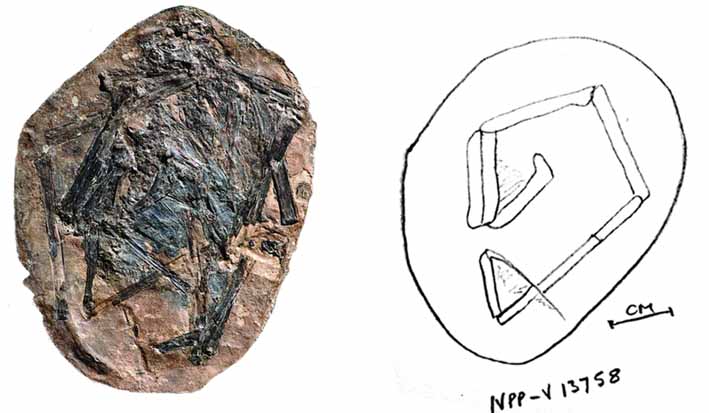
Avodectes pseudembryon (Wang and Zhou 2004),was discovered in the Jehol Biota, being about 121 million years old. It was a complete embryo in a shell. The wings were coiled as they developed and the preservation indicates clearly that the bones were well ossified before hatching. This would enable the newly hatched pterosaurs to use the wings very quickly after emerging from the egg. This specimen was preserved on a slab as part and counterpart - IVPP V 13758..
Observations of the porosity of the egg shell suggested
possible burial during development and the form of the shell was soft
and leathery like a reptilian egg, having a shell that was non-laminar
and 0.25mm thick. The embryo wingspan was estimated to be 27cm. The
bone proportions are unlike any known pterosaur, but show similarities
with Anhanguera and Istiodactylus
specimens. This should not be taken as an indication of species, since
the bone development and proportions may have been subject to changes
during juvenile life.
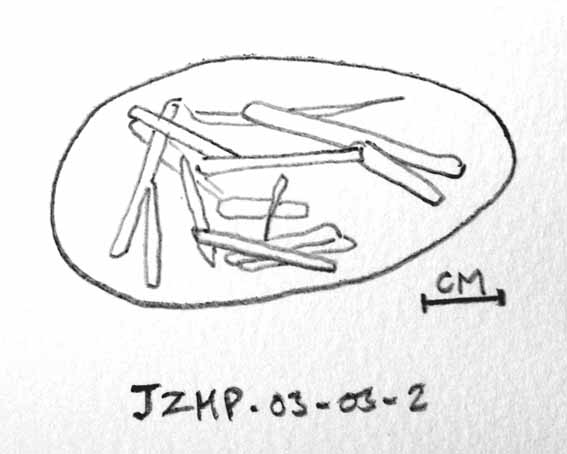
A second egg, JZMP-03-03-2, was somewhat similar, but the skeletal
bones were not articulated in the same clear way, so interpretation is
a little more complex.